Replacing junior work with AI may also erase the path to judgement.
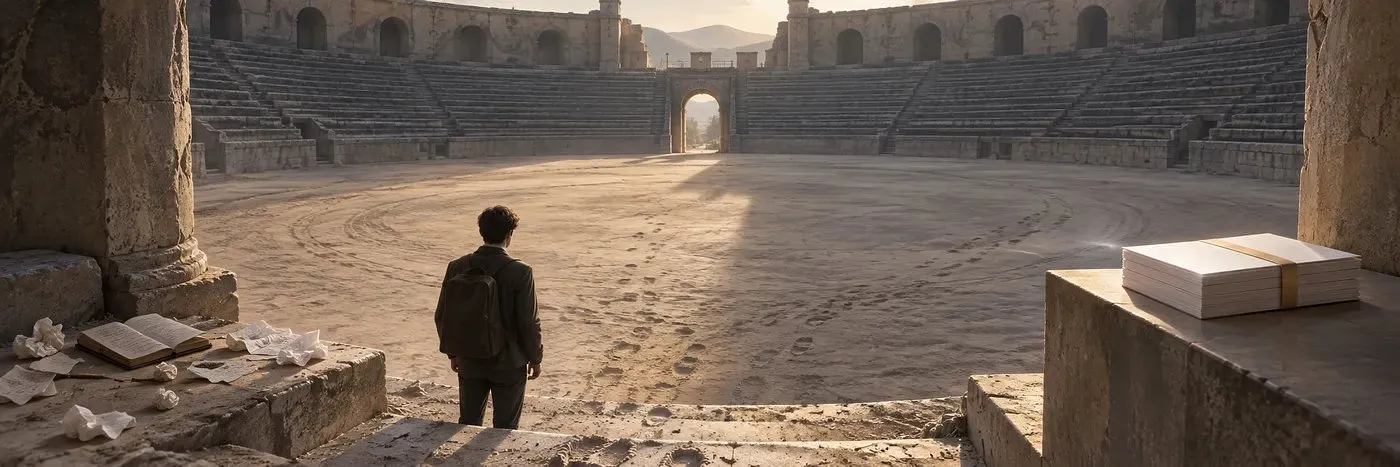
I haven’t written in a year.
Partly a job change. Partly a handful of personal things that needed sorting out before anything else could get attention, including writing. The one thing I never dropped, through all of it, was mentoring. A few young designers, some inside pharma, some outside, asking the same question I once asked, in a world that answers it very differently now.
And somewhere in the middle of trying to figure out the right path for them, a path that keeps changing under my feet as I describe it, I realised something less comfortable. If theirs is up for redesign, mine probably is too. So is the path of anyone who stopped being junior a while ago and quietly assumed the ladder they’d already climbed was still standing.
That’s the real reason for the silence, I think. Not the job, not the personal stuff, those were just the excuse to finally sit still long enough to notice it.
So this piece starts there. Selfish, as most honest writing is.
The activity was never the point
There’s a piece I read recently (Fast Company, riffing on an idea worth stealing) that argues something simple and uncomfortable: a huge share of what we used to call “junior work” wasn’t really about the output. Building the model, drafting the deck, writing the first pass of anything. The deliverable was the excuse. The real product was judgement, assembled one repetition at a time.
AI is extremely good at producing the deliverable. It is not, yet, a way to assemble judgement in someone who doesn’t have it. We are automating the production side faster than we are redesigning the apprenticeship side, and those are not the same project, even though they currently share a budget line.
The article’s proposed fix is medicine: residency. Supervised exposure, escalating responsibility, feedback loops designed on purpose instead of left to chance.
I like the idea. I’ve also stood in rooms where it either worked, or very visibly didn’t. Three rooms, actually, three different trades, three different ways of watching the same mechanism run, or stop running.
The first one wasn’t even mine. I just sat close enough to it for years.
From pyramids to obelisks
I’ve spent years around the big consulting names. BCG, McKinsey, the usual cast. I won’t name the specific one, but you can guess.
They used to be pyramids. Wide base of juniors, feeding a narrower layer of seniors, feeding an even narrower layer at the top. That base wasn’t decoration. It was the training ground.
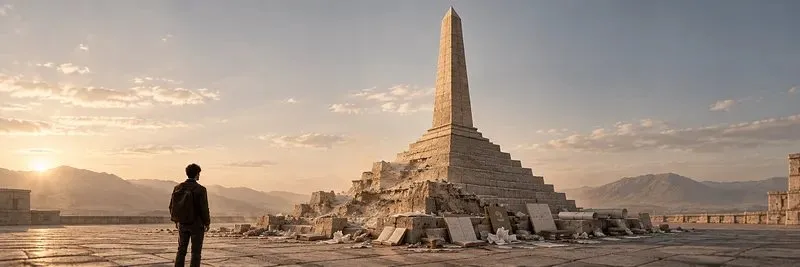
A senior partner once described it to me with a phrase I never forgot: they sent juniors into the arena not to win, but to come back alive. Because on a lot of client questions, “winning” was negotiable anyway, open to interpretation, defensible either way if you argued it well enough.
So the junior would walk in front of a client who had a real, specific need, understand maybe sixty percent of it, and improvise the rest live. Output was often rough. Those rough outputs, multiplied across enough juniors, across enough years, probably did as much to build the industry’s reputation for expensive vagueness as anything else.
But the ones who survived the arena grew fast. Genuinely fast. They climbed because the exposure was brutal and constant, and brutal constant exposure is still, as far as I can tell, undefeated as a teacher.
The pyramid is turning into an obelisk. Not empty, I won’t pretend I have the headcount data, but visibly thinner where the juniors used to stand, and getting thinner every year.
Some of the work clients once paid a junior team, plus a senior’s oversight, to produce, can now be generated in minutes, often well enough that the old economics become hard to defend in a budget meeting. The price that used to be monetary, and absurdly visible on an invoice, has become invisible and functionally free.
Nobody sends anyone into the arena anymore. Which also means nobody comes back from it changed.
The consulting arena was loud, client-facing, built on live improvisation in front of an audience.
The second room I want to tell you about had none of that. No audience. No negotiation. Just a body on a table that either responded to what you’d designed, or didn’t.
The table with no notes
I’ve spent a lot of time in medical device design, which meant, more than once, standing in that room, in front of a stainless steel table with a cadaver on it.
Cadaver testing strips away almost everything except the thing itself. You can walk in with every credential, every study, every prior case you’ve ever read. None of it substitutes for what happens when a surgeon and a designer actually have to understand each other in front of tissue that doesn’t care about your slide deck.
Often, we walked out without the result we wanted. The device didn’t behave the way the simulation promised. The grip was wrong. The angle nobody had modelled. That happened more than I’d like to admit.
But on the sessions where it did come together, something else happened too, almost as a side effect. Everyone in that room left having quietly absorbed a layer of know-how nobody had written down. Reasons behind choices. Instincts about what a clinician will actually reach for under pressure, versus what looks elegant in a rendering.
That knowledge didn’t come from the successful outcome. It came from standing in the room while the outcome was still uncertain, next to someone whose expertise you had to earn access to in real time.
I don’t know how you simulate that. I suspect you don’t. I suspect that’s the point.
Two rooms down, one to go, and this one is the trade I actually trained in.
Pencil to pencil
My first chief designer had a line he repeated until it stopped sounding like advice and started sounding like a law of physics: you start with the pencil, and you go back to the pencil.
In between: markers, technical pens, airbrush, lacquers, every analogue tool a design studio could own. Then digital tools arrived. Then 3D, and with it, photorealistic rendering that let almost anyone produce something that looked finished.
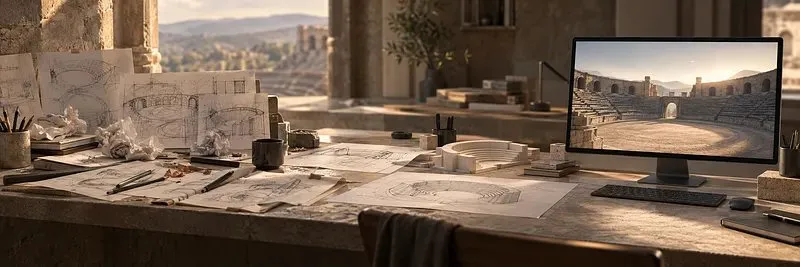
The public loved it instantly. The people who’d actually trained on paper noticed something else, harder to name at the time. The pencil was never valuable because it was analogue. It was valuable because it was slow, imprecise, and stubborn, and that resistance forced you to build a mental model before the page could show you anything. Rendering skipped straight to the finished image. It made thinking optional, which is a strange thing to make optional in a discipline whose entire job is thinking made visible, including the bad thinking, the wrong turns, the version four that taught you what version seven should look like.
There’s a comparison I keep coming back to, more as an analogy than a proof. A modern film built entirely on CGI can show you literally anything, so it often shows you everything, and leaves nothing for your imagination to complete. A 1950s sci-fi film, working with a fraction of the budget and none of the technology, had to leave gaps, and your mind did the finishing work. Call it productive incompleteness: certain constraints force whoever’s producing something, and whoever’s receiving it, to think. Remove the constraint, and you often remove the thinking along with it.
I wonder if we’re doing the same thing to junior work now. Removing the gaps. Removing, along with them, the exact place where understanding used to form.
Three rooms. A consulting arena, a cadaver table, a drawing board. Different decades, different stakes, same underlying architecture: something incomplete, something that actually mattered, and someone standing next to you who already knew more. The apprentice had to close that gap themselves, in front of a witness. That’s what built the judgement.
AI is very good at closing the gap first, quietly, before anyone has to stand there and feel it open. Which brings me back to where I started, and to the question I couldn’t quite dodge.
So, back to me
I said this piece started selfishly, and it ends there too.
While I’ve been coaching younger designers on how to build judgement in a world that keeps handing them finished answers, I kept circling back to an uncomfortable mirror. If more of the uncertainty can now be resolved before we ever reach the cadaver table, if the pencil is optional, if the junior gets the polished answer before having to build the ugly first one: what exactly am I still doing that builds anything in me?
Mentoring, it turns out, is not just something I do for them.
It might be the last arena I’ve got left.