Why Patient-Centricity doesn’t know how to measure itself

I. The truth hiding in plain sight
Over the past years, conversations with health authorities, pharma teams, research institutes, and design leaders have steadily converged, like tributaries feeding a single river, towards one uncomfortable truth:
Everyone in healthcare and pharma wants to be patient-centric, yet almost no one can demonstrate with rigorous evidence whether, how, and to what extent these efforts actually improve patients’ lives.
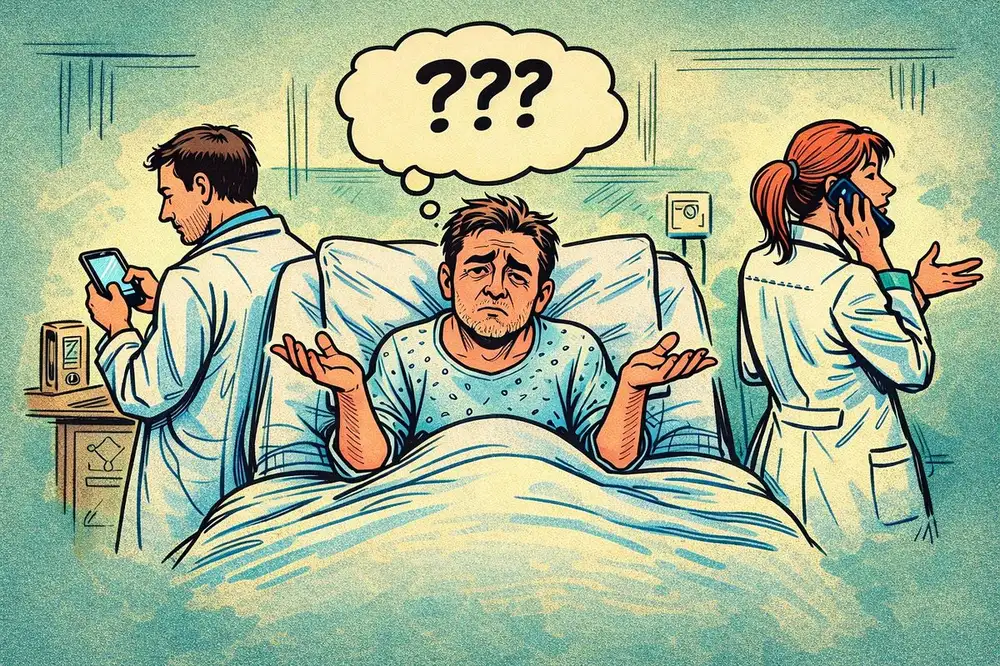
Patient-centricity is not merely “putting the patient first” as a slogan, nor is it limited to collecting feedback or running empathy workshops.
At its core, patient-centricity is the disciplined practice of designing healthcare solutions, products, services, pathways, and policies around the full reality of the human being temporarily labelled as a “patient”.
Clinical needs matter, but so do behavioural capacities, emotional burdens, logistical constraints, social contexts and unspoken fears.
True patient-centricity succeeds only when it measurably improves lived outcomes: better adherence, reduced suffering, restored dignity, and lives less disrupted by illness.
Everything else, no matter how well-intentioned, risks remaining ceremonial.
The problem is not aspiration. The problem is evidence.
At this level, patient-centricity looks simple. Almost obvious.
And this apparent simplicity is precisely what makes the problem invisible.
1. When agreement hits reality
Agreement on principles does not translate into alignment in practice.
The moment patient-centricity leaves decks and declarations and enters real decision-making arenas with funding, governance, prioritisation, accountability, a different question inevitably emerges:
How do we know it is working?
Not whether it is desirable.
Not whether it is morally right.
But whether it can be demonstrated, defended, and sustained inside systems that allocate finite resources under constant pressure.
This is the point where patient-centricity stops being a shared aspiration
and becomes a measurement problem.
In complex systems, moral alignment is not enough. Decision-making demands evidence.
A brief story illustrates why:
Some weeks ago, during a strategy discussion in the UAE with a senior government healthcare leader, a person whose facial expression alone could terminate a multimillion-euro initiative, he said something that lodged itself in my mind like a splinter:
“If it isn’t measured, it doesn’t exist.”
He didn’t say it as a provocation.
He said it as a fact.
And there’s the paradox:
we are trying to build patient-centricity on top of a measurement culture that doesn’t yet exist.
What he was really asking, I realised, was whether the technical layer of UX could be transplanted into healthcare as-is.
Measurement frameworks, dashboards, efficiency metrics, the full package. If it were only that easy.
What he was not asking was how to measure the human variability that sits beneath those tools.
The ambiguity, the fear, the adaptive behaviours that emerge when real life collides with a designed system.

2. “PATIENT” is a linguistic trap.
The word patient feels neutral. It isn’t.
It compresses a complex human reality into a functional label, one that quietly strips context, agency, and variability out of the picture.
Patient is not a job title.
It is a temporary condition imposed on a human being who never asked to enter the system defining it.
Designing for someone who fundamentally does not want to be “a patient” requires a level of rigor that goes far beyond empathy workshops and colourful journey maps. It requires abandoning the illusion that needs are stable, explicit, and neatly articulable.
You cannot design for a human using only the needs they know how to express.
Some needs are unspoken. Some are misarticulated. Some are contradictory. And some emerge only when life pressure, logistics, fear, shame, social roles, family obligations, and medical complexity collide.
This is why patient journeys almost never behave like the linear diagrams we draw. No journey is a line. It is a system: a dynamic, multi-actor network of constraints, trade-offs, adaptations, and frictions that evolve over time.
What we often call “patient behaviour” is, in reality, human adaptation to system design.
Which leads directly to the core problem.
If you cannot measure the system, you cannot change it. If you cannot change it, you are not doing patient-centricity.
You are doing patient theatre.
This is where most teams fail, not because they lack talent or intention, but because they lack a measurement architecture capable of distinguishing:
- expressed needs vs. latent needs
- individual needs vs. systemic constraints
- emotional friction vs. operational friction
- symptom relief vs. quality-of-life impact
- activity vs. outcome
And without this architecture, organisations fall back to what is easiest to measure, not what is meaningful.
Surveys. Sentiment. Awareness. NPS.
The metaphors of impact, not the impact itself.
Meanwhile, the real questions that determine whether a person’s life actually improves remain unasked, unmeasured and unseen.
This article is an attempt to change that.
Not by offering a universal solution, but by outlining the systemic foundations required before patient-centricity can become a discipline rather than a declaration.
II. The architecture of what we cannot see
Let’s start from a simple premise:
You cannot improve what you cannot measure, and you cannot measure what you have not properly defined.
So let’s define it where it matters,
Not in slogans or PowerPoints,
But in the language of systems, behaviour, and evidence.
If the first part of the problem is acknowledging that patient-centricity cannot exist without measurement, the second part is even more unsettling:
we do not yet measure the things that matter, because we still do not know how to see them.
Healthcare systems were engineered for diseases or, more precisely, for stable variables and biological signals that can be isolated, controlled, and repeated.
Human experience is the opposite.
It adapts.
It compensates.
It breaks, quietly, under pressure.
This mismatch is not philosophical, it’s real. It is structural.
We have exquisite frameworks for tracking biological progression, treatment efficacy, adverse events, and clinical endpoints.
But when it comes to lived experience such as the emotional, logistical, behavioural, and systemic forces that determine
whether a treatment actually works in real life, the data landscape often collapses into anecdote.
The irony is brutal:
We measure what is easy, not what is meaningful.
1. Metrics in Healthcare vs Metrics in Human Experience
Clinical metrics are clean.
Blood pressure, FEV1, HbA1c, exacerbation rates. They are stable, isolatable, repeatable.
Human metrics are not.
Fear, overwhelm, forgetfulness, stigma, logistics, family burden.
They are contextual, adaptive, and often invisible to traditional measurement systems.

And yet, it is precisely these “messy” variables that most often determine
adherence, outcomes, cost, and inequity.
The same clinical protocol can produce radically different results
in the life of a retired engineer with a car and a partner than in the life of a single parent working two jobs and relying on public transport.
Not because of biology,
but because inequity hides in logistics, literacy, access, time,
geography, and caregiving pressure.
This is where systems thinking becomes indispensable. Not as a philosophical lens,
but as an operational necessity.
A patient does not exist in isolation.
What we call a “patient” is always embedded in a system,
a network of touchpoints, actors, incentives, constraints, and expectations
that continuously shape behaviour and outcomes.
Without modelling that system, its interactions, frictions, and feedback loops, no metric will ever make sense. No matter how precise.
2. Why Patients Cannot Simply “Tell Us What They Need”
You cannot ask someone in crisis to produce a requirements document.
When people are ill, overwhelmed, or navigating uncertainty,
they do not articulate needs the way systems expect them to.
They express fragments:
what they think they want,
what they believe they are supposed to say, what they can articulate under emotional strain, what aligns with their social, cultural, or moral identity.
But these expressions are not needs in a design or systems sense.
They are signals.
The most consequential needs (operational, behavioural, systemic, emotional) often remain unspoken. Not because patients are withholding information, but because many needs are difficult to recognise from the inside.
People are rarely aware of the constraints shaping their own behaviour.
They normalise friction.
They adapt silently.
They compensate until compensation becomes exhaustion.
This is why asking patients “what they need” is necessary, but insufficient.
Needs are not inputs.
They are raw data.
Requirements are something else entirely.
They are the result of interpretation, prioritisation, and translation across multiple layers of constraint: biological, cognitive, emotional, logistical, social, and systemic.
Imagine asking a crying child pointing at their arm whether the pain might be caused by a fractured ulna or radius.
The question is absurd, not because the child is incapable,
but because diagnosis, abstraction, and prioritisation are responsibilities of the system, not of the person in distress.
The same applies here.
Between what people feel, what they can articulate, and what the system can realistically change, there is a long translation gap.
Bridging that gap requires more than surveys or focus groups.
It requires methods designed to surface what is latent, contradictory, adaptive, or invisible:
ethnographic research,
contextual inquiry,
behavioural observation,
stakeholder-journey mapping,
and analysis of systemic constraints.
This is where patient-centricity stops being about listening
and becomes about interpretation.
And this is also where it inevitably expands beyond the patient alone.
3. Stakeholder Journeys, Not Just Patient Journeys
Once we accept that needs cannot be extracted directly from patients,
another consequence becomes unavoidable: the patient journey, as it is commonly represented, is incomplete.
Every so-called “patient journey” is in reality a stack of interacting journeys.
What we label as patient experience is the emergent outcome of multiple actors navigating the same system under different constraints, incentives, and pressures.
Consider the care pathway not as a line,
but as a convergence of parallel journeys:
the clinician attempting to balance empathy, protocol, and time scarcity
the nurse navigating staffing ratios, shift fatigue, and operational overload;
the caregiver absorbing invisible emotional and logistical labour;
the pharmacist managing access, reimbursement rules, and rushed counseling;
the payer optimising sustainability under political and budgetary pressure
the policymaker balancing population outcomes, regulation, and public trust
These journeys do not run alongside the patient by coincidence.
They actively shape one another.
A constraint in one journey frequently materialises as friction in another.
What appears as non-adherence at the patient level may originate as time pressure in clinical practice, reimbursement rigidity at the system level, or logistical fragility in everyday life.
In this sense, many “patient failures” are not failures at all.
They are downstream effects of upstream system decisions.
This is why mapping the patient journey in isolation creates a dangerous illusion of clarity.
It captures touchpoints,
but misses interactions.
It documents steps,
but obscures causality.
If patient-centricity is to be measured meaningfully, it must be observed where these journeys intersect, not where they are artificially separated.
This is also where health equity becomes visible.
Equity does not emerge from intentions or values statements.
It emerges (or collapses) at points of friction: where time, access, cost, literacy, geography, and caregiving responsibilities accumulate unevenly.
Across stacked journeys,
some actors consistently absorb more friction than others.
And very often,
it is the same people who are already most vulnerable who end up paying the highest “friction tax.”
Before defining metrics,
we therefore need, at minimum:
- a clear map of core stakeholders
- their respective journeys across the same care pathway
- the recurrent frictions and compensations they generate
- explicit system boundaries: where responsibility realistically begins and ends
Without this, metrics float in conceptual space. They optimise isolated touchpoints
while structural inequities remain untouched.
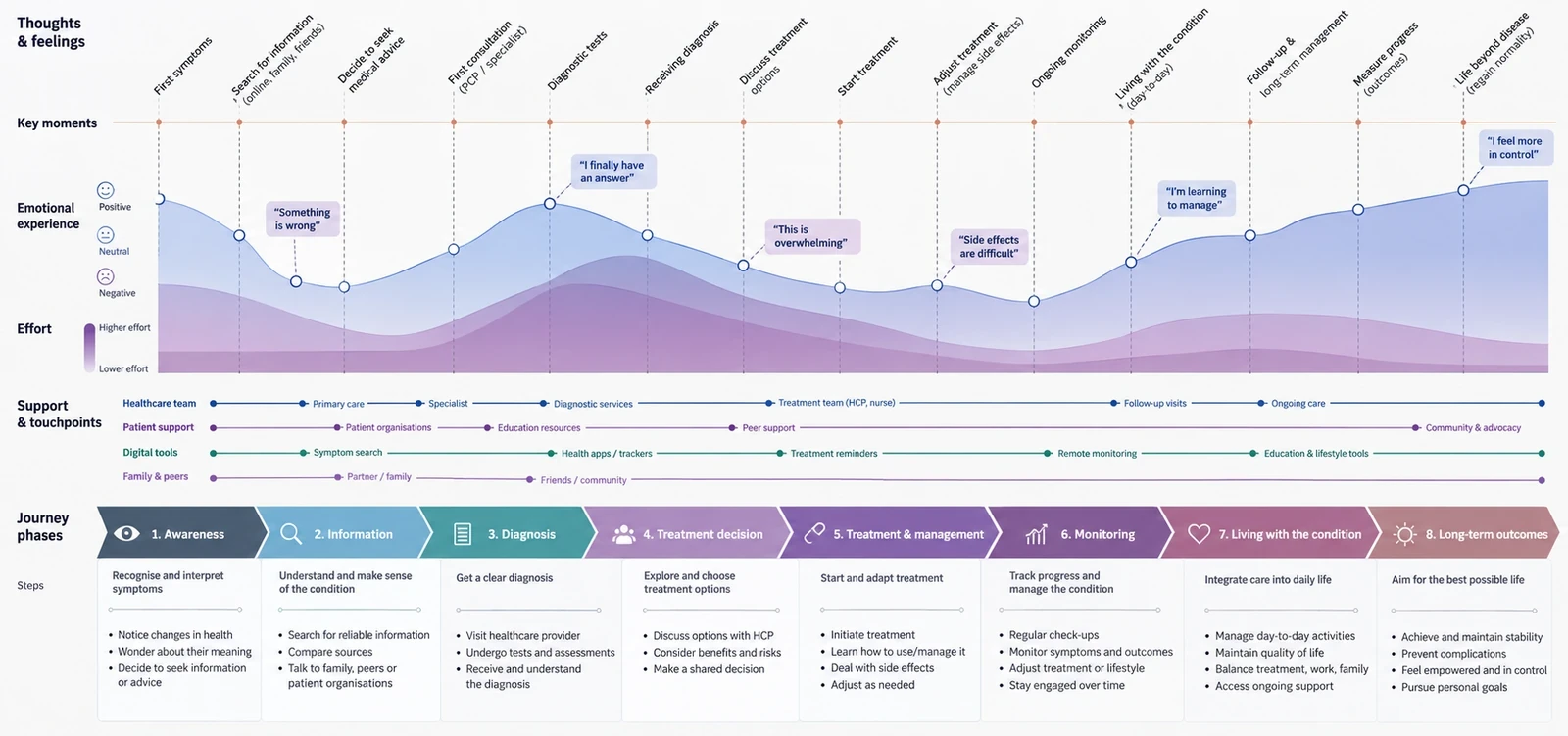
A stacked journey map does not describe experience. It reveals where friction concentrates, shifts, and multiplies.
And without making those interactions visible, patient-centricity remains an aspiration,
not a system that can be measured, governed, or improved.
4. The “Measurement Blindness” Problem
At this point, a deeper issue becomes impossible to ignore.
Most healthcare measurement frameworks suffer from a specific form of blindness:
they assume that people behave as the system expects them to behave.
They do not.
Processes describe ideal behaviour.
Humans operate under real conditions.
Medicine offers decades of evidence of this gap:
- inhalers misused despite correct prescription
- insulin titration misunderstood despite education
- chronic patients skipping doses to “save medication for later”
- diagnostic follow-ups abandoned due to logistical burden
- clinically effective therapies failing outside trial conditions
In each case, the failure is rarely biological. It is behavioural, contextual, or systemic.
This is why declared behaviour (what patients say) and observed behaviour (what patients actually do) diverge so dramatically.
And yet, most measurement systems rely heavily on declarations:
- self-reported adherence
- satisfaction surveys
- engagement scores
- intent-based questionnaires
These tools are not useless.
But they are dangerously incomplete.
They capture intention, not adaptation.
They reflect aspiration, not constraint.
They document compliance with the idea of the system, not survival within it.
This is not a gap in measurement science. Validated patient-reported outcome instruments exist, and regulators accept fit-for-purpose ones as evidence: for a symptom such as pain, what the patient reports is the measure. The gap I am describing sits elsewhere: between declared behaviour and the context, burden and constraints that shape it, and between those measures and the decisions organisations actually take.
When metrics rely primarily on declared behaviour, systems end up measuring performance,
patients performing the role they believe is expected of them.
This creates a subtle but harmful distortion: responsibility shifts silently from system design to individual behaviour.
Missed appointment? Framed as lack of motivation. Non-adherence? Framed as poor engagement. Drop-out? Framed as personal choice.
In reality, these are often signals of:
transportation barriers, shift work and time scarcity, caregiving overload, financial pressure, health literacy gaps , stigma and fear, etc
Without stratifying observed behaviour by context, measurement systems misinterpret cause as choice.
This is the core of measurement blindness: we mistake adaptation for non-compliance, and system limits for human failure.
And this misinterpretation has consequences. Because when a system believes the problem is X, while the real problem is Y,
every solution it designs will be optimised for the wrong target.
- If non-adherence is interpreted as lack of motivation,
the response will be education. - If drop-out is framed as disengagement, the response will be communication.
- If missed appointments are seen as personal choice, the response will be reminders.
But when the real drivers are cognitive load, logistical friction, time scarcity, financial pressure, or competing survival priorities,
these solutions do not fail loudly.
They fail silently.
They add effort where relief was needed.
They increase burden where capacity was already exhausted.

This is why patient-centricity initiatives often look active,
well-intentioned, and busy, yet produce little measurable change in real lives.
Unless patient-centricity metrics are grounded in real-world behaviour,
observed longitudinally, and interpreted through contextual lenses, they do not reveal truth. They produce narratives. Comfortable ones. Often reassuring.
And dangerously misleading.
To measure patient-centricity seriously, we must stop asking only what people say and start observing what they do, where they do it, and what they are compensating for.
This is not a methodological nuance.
It is the difference between designing for the problem we imagine
and designing for the problem people actually live with.
5. The Human in the System
(Where all realities collide)
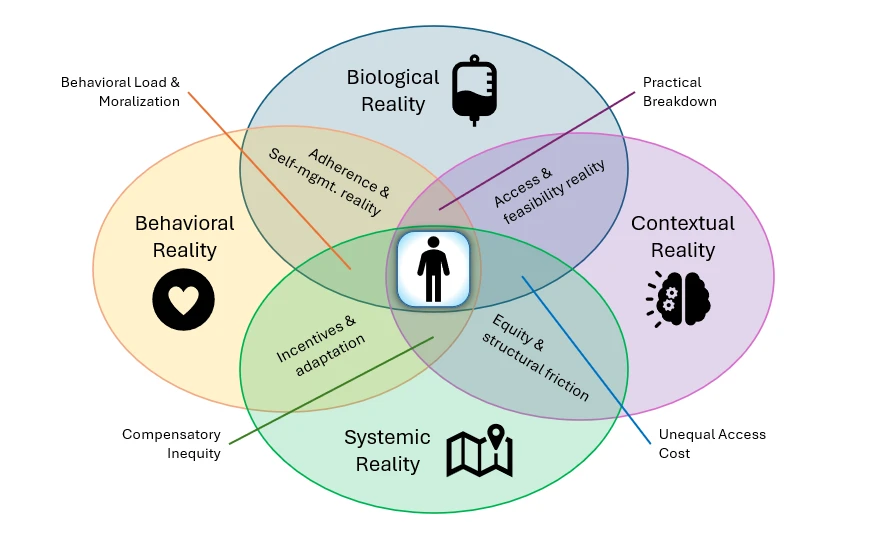
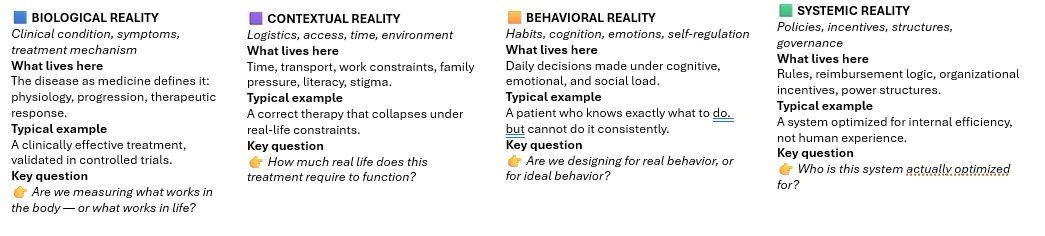
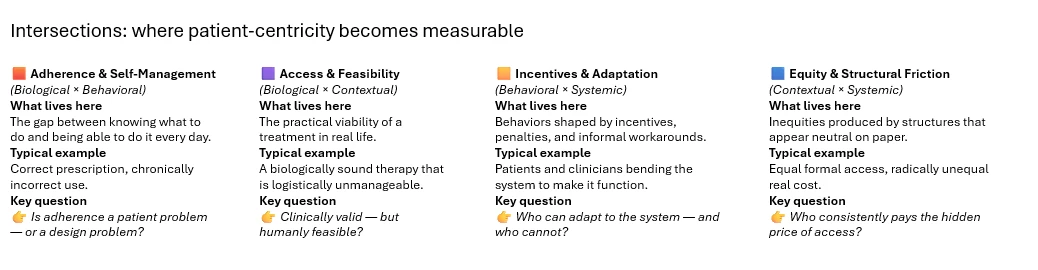
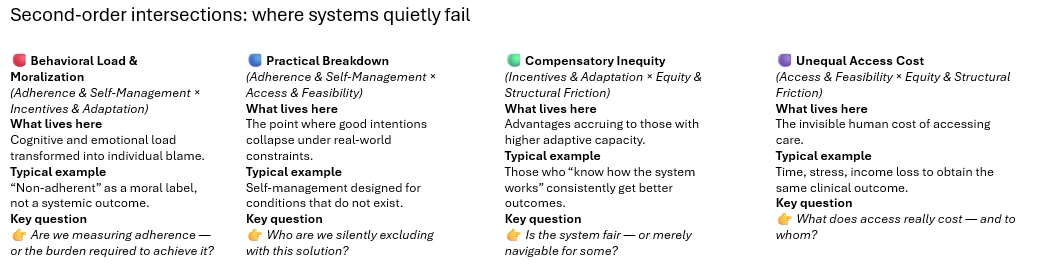
At the centre is the human cost of system design.
This map does not describe patient experience. It describes where patient-centricity becomes measurable and where it most often disappears.
Most existing metrics live comfortably inside one reality at a time:
- clinical efficacy,
- access indicators,
- engagement scores,
- system performance.
But people do not live inside single realities. They live at the intersections.
where biology collides with behaviour,
access collides with feasibility,
and system incentives reshape human adaptation. This is where equity quietly decides who carries the hidden cost of care.
This is where the most consequential failures occur. Not at the edges of the system,
but in second-order intersections
where individual effort compensates for structural design limits,
and human burden is mistaken for personal responsibility.
A human being temporarily labelled as a “patient” navigates biological variability, behavioural capacity, contextual constraints,
and systemic incentives simultaneously; often under stress, uncertainty, and asymmetrical power.
This is not an average. It is not a persona. It is not a segment.
It is the point of collision where:
biological reality meets behavioural adaptation, personal resilience meets contextual constraints, individual effort meets systemic incentives, care intent meets lived reality.
This is why two people with the same diagnosis, the same prescription, and the same clinical pathway can experience radically different outcomes.
Not because of biology.
But because of everything around it.
Patient-centricity cannot be measured by isolating variables.
It can only be measured where real life absorbs the consequences of system design.
Where success is enabled and failure is silently outsourced to human effort.
6. Evidence Generation: the missing capability

At this point, a deeper gap becomes visible.
Patient-centricity does not primarily suffer from a lack of good intentions, frameworks, or engagement activities.
It suffers from a lack of evidence generation logic capable of operating at the level where human behaviour, context, and systems collide.
Most healthcare organisations collect data.
Very few generate evidence.
This distinction matters.
Data answers the question: what happened? Evidence answers a harder one: why did it happen, under which conditions, and what would change if the system were designed differently?
Today, most patient-centric initiatives generate fragments:
survey scores, engagement metrics, qualitative quotes, workshop outputs, isolated KPIs.
Each fragment may be valid on its own.
Together, they rarely form evidence.
Evidence generation requires something more demanding:
a structured link between system design choices, observed human behaviour, and measurable outcomes over time.
Without this link, patient-centricity remains descriptive.
With it, it becomes actionable.
The problem is not that evidence is impossible to generate.
It is that we keep asking the wrong layer of questions.
We ask:
- Did patients like the experience?
- Did engagement increase?
- Did awareness improve?
But we rarely ask:
- Which system constraint forced behavioural adaptation?
- Where did human effort compensate for design limits?
- Which part of the journey transferred hidden cost onto the patient or caregiver?
- Which outcome changed because the system changed, not because the person tried harder?
Evidence generation starts exactly there.
Not from opinions, but from observed behaviour under constraint.
Not from isolated touchpoints, but from longitudinal patterns across the journey. Not from averages, but from variance, friction, and failure modes.
This is also where many existing approaches stall.
Clinical research excels at controlling variables. Real-world patient experience is defined by variables that cannot be controlled, only understood: time pressure, logistics, cognitive load, social roles, fear, stigma, power asymmetry.
Generating evidence in this space does not mean abandoning rigor.
It means redefining rigor.
Rigor here means:
- observing behaviour where systems apply pressure,
- mapping how people adapt, workaround, delay, or disengage,
- and linking those adaptations back to specific system decisions.
Without this step, organisations misidentify the problem.
They treat non-adherence as motivation.
They treat drop-out as preference.
They treat inequity as individual failure.
And when the problem is misdiagnosed,
the solutions are inevitably designed for the wrong cause.
This is the silent cost of weak evidence generation: interventions optimised for intent,
applied to problems driven by constraint.
Patient-centricity becomes busy. Not effective.
To mature as a discipline, patient-centricity must therefore evolve from data collection to evidence generation:
from describing experience to explaining behaviour, and from explaining behaviour to redesigning systems.
Only then can measurement stop producing narratives and start producing decisions.
7. The limit of Measurement
Measurement does not fail because humans are irrational.
It fails because we persist in measuring humans as if they were stable components.
Healthcare systems excel at measuring what is repeatable.
Human experience is not.
This is why no single metric, framework, or certification will ever be sufficient.
- Not experience scores.
- Not behavioural indicators alone.
- Not system KPIs.
- Not outcomes in isolation.
Each of these lenses captures something real. Each becomes dangerous the moment it is mistaken for the whole.
The mistake is not measuring.
The mistake is expecting measurement to resolve what is structurally unresolved.
Patient-centricity will never be “fully measurable” in the way blood pressure is.
But it can be measured well enough to guide decisions, allocate resources, and reduce avoidable harm.
That is the real threshold.
Not precision, but responsibility.
A responsible measurement architecture does not promise control.
- It acknowledges uncertainty.
- It accepts variability.
- It makes visible the trade-offs, frictions, and hidden costs that systems routinely externalise onto individuals.
Without this humility, metrics become cosmetic. They reassure organisations while obscuring reality. They generate confidence without comprehension.
And this is where the conversation must move beyond healthcare itself.
Because the hardest system to measure is not clinical. It is human.
III. Building what doesn’t exist yet

The Human System is still the hardest system.
Even NASA, still one of the few organisations able to land a rover on Mars with a 14-minute communication delay, openly and candidly admits something healthcare rarely says aloud:
The human system is still not fully understood or measurable.
It remains the least predictable, least controllable, and least measurable component of any complex system
NASA can model fuel consumption to the gram. It can predict structural vibration years in advance. It can simulate orbital decay with astonishing precision.
But predicting human behaviour under stress, ambiguity, cognitive overload? that’s way more complex and way less predictable.
It remains one of the biggest unsolved variables, not because of a failure of technology but because this variability is a property of human systems.
This is why NASA created Human Systems Integration (HSI):
“Human Systems Integration (HSI) ensures human capabilities and limitations are effectively considered in system design and development…”
(NASA Human Research Roadmap)
And yet, Mars-analogue studies (arXiv, 2021) still reveal gaps:
- cognitive overload not predicted by simulation
- drift in decision-making
- inconsistencies in human-computer interaction
- mismatches between interface logic and human planning intent
If even NASA, with extreme telemetry, controlled environments, and half a century of human-factors expertise, acknowledges that human behaviour under real conditions remains an unresolved variable, then healthcare, which barely measures lived experience at all, is still at the very beginning of this journey.
This matters for a simple reason: because patient-centricity is fundamentally NOT a clinical problem but a human-systems problem.
1. The 70/30 Reality of Patient-Centricity
In my experience, only about thirty percent of patient-centricity measurement is technical.
That thirty percent includes tools, frameworks, surveys, dashboards, and indicators.
It matters, but it is not where most initiatives fail.
The remaining seventy percent lives elsewhere:
- in organisational design,
- in governance and decision rights,
- in political navigation,
- in boundary-setting,
- in how stakeholder journeys are aligned, or left to collide.
This is why many organisations sincerely believe they are “doing patient-centricity” while outcomes remain stubbornly unchanged.
They measure what is technically accessible, but struggle with what is structurally uncomfortable.
What often remains implicit, the translation of insight into architecture, governance models, KPIs versus KVIs, equity-aware journeys, cross-functional alignment, and system redesign, is not missing by accident.
2. What a Real Measurement Architecture Would Unlock
Patient-centricity pays today its biggest bill because people disagree on its importance. It fails because they silently disagree on what value actually means.
For some, value is clinical efficacy, for others, it is access, speed, cost containment, risk reduction, or operational efficiency.
For patients, value often means something far less abstract: fewer disruptions, less cognitive load, less invisible effort just to make the system work.
As long as these definitions remain implicit and misaligned, patient-centricity cannot mature.
Before we can measure patient-centricity, we need to agree on what value we are trying to create, and for whom.
And this is precisely where the conversation inevitably turns uncomfortable.
4. ROI Becomes the First Alignment Tool

If organisations were forced today to align on a single definition of value, especially inside large healthcare or pharma companies, most discussions would converge on one place:
return on investment.
Not because ROI captures everything that matters, but because it is the only construct everyone already understands.
In complex organisations, value is ultimately expressed through allocation:
what gets funded, what scales, what survives internal competition.
And allocation decisions are always implicit judgements about expected return. We invest because we believe something will come back economically, operationally, strategically.
This is why translating patient-centricity into ROI is not a betrayal of its intent. It is the most pragmatic way to create alignment on value across stakeholders who otherwise speak incompatible languages.
However, this translation only works under one condition:
ROI must be grounded in evidence that reflects real human and system behaviour.
Not vanity metrics.
Not engagement theater.
Not isolated success stories.
But evidence showing how patient-centric
interventions:
- reduce avoidable costs,
- prevent downstream failures,
- stabilise adherence over time,
- lower caregiver burden,
- mitigate inequity-driven inefficiencies,
- and improve outcomes because they reduce friction in real life.
This is where patient-centricity, ROI, and evidence generation stop being separate conversations.
- ROI becomes the alignment mechanism.
- Evidence generation becomes the credibility engine.
- Patient-centricity becomes the design logic that connects the two.
Final Reflection: From Value to Evidence
Patient-centricity will not mature through better intentions.
It will mature when value is made explicit, measurable, and comparable.
Evidence generation is the first step in this direction. It is what allows organisations to see, not assume, how human behaviour, system design, and contextual constraints interact over time.
ROI, when informed by that evidence, becomes more than a financial metric. It becomes a coordination tool aligning incentives, clarifying trade-offs, and protecting investments that genuinely reduce human burden instead of shifting it elsewhere.
This is not about proving that patient-centricity is “worth it”.
It is about making sure that what is worth doing is actually recognised, funded, and sustained.
When evidence generation, value definition, and ROI converge,
patient-centricity stops being aspirational.
It becomes executable.